Award recognizes Cambodian and IRRI scientists for tracing 30 years of rice research
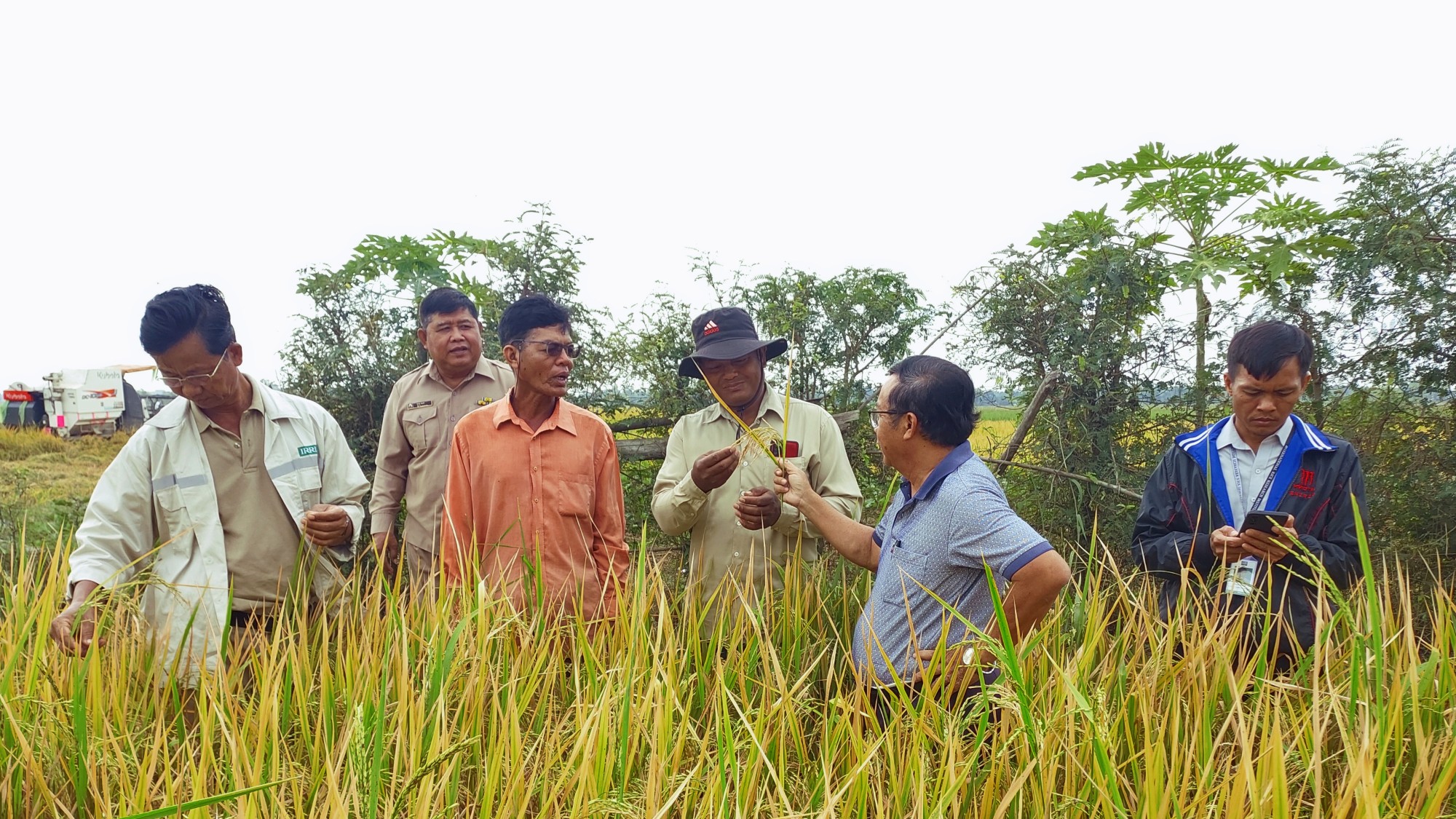
A review of three decades of rice research in Cambodia has been selected for the Crop Science Society of Japan’s (CSSJ) 24th Best Paper Award, reflecting how research advancements have helped transform the country's rice sector.
Since 1993, Cambodia’s rice output has increased fivefold, from nearly 2.4 million tons to an estimated 14 million tons in 2024, evolving from being primarily a producer for local needs into a more intensive, market-oriented industry. In 2023, the country exported over 656,000 tons of milled rice to international markets.
Published in Plant Production Science in 2025, the paper, “History and progress in rice research and its future perspective in Cambodia,” traces how research has supported this growth and where it could go next.
The review was written by researchers from the International Rice Research Institute and two agencies under Cambodia’s Ministry of Agriculture, Forestry, and Fisheries: the Cambodia Agricultural Research and Development Institute (CARDI) and the General Directorate of Agriculture (GDA).
Tracing developments in rice breeding, crop establishment, pest management, and soil and nutrient management, the authors attribute Cambodia’s rice-sector transformation to the widespread adoption of improved, high-yielding, and aromatic rice varieties, major shift from manual transplanting to direct-seeded rice (DSR) to address labor constraints, increased agricultural mechanization for land preparation and harvesting, and greater use of inorganic fertilizers guided by soil-specific nutrient management recommendations.
These developments were enabled by the decades of collaboration between Cambodian research institutions and IRRI, sharing technical and local expertise.
Beyond accomplishments, authors also highlighted opportunities to fill the gap between the potential yields farmers could achieve and actual harvests in both irrigated and rainfed areas.
Scientists recommend focusing on integrated approaches combining improved varieties, optimized nutrient management, and integrated pest management strategies to strengthen the sustainability of local rice production. They also call for stronger agricultural extension services, farm diversification, and better access to technologies farmers can adopt.
“The next transformation in Cambodia’s rice sector will depend on how well research, policy, services, and markets work together,” said Dr. Kazuki Saito, IRRI Scientist and lead author of the paper. “Public investment can strengthen local research and extension, service providers can make quality seed and machinery more accessible, and millers and buyers can reward grain quality. When these pieces come together, progress on individual farms can translate into gains across the sector.”
With global rice demand projected to increase by 30% by 2050, closing Cambodia's yield gap could strengthen its contribution to future rice supplies while supporting more sustainable production.
The authors of the paper include Kazuki Saito, Nurmi Pangesti, Rica Joy Flor, Chanthol Uch, and Alice Laborte from IRRI; Sathya Khay and Chourn Orn from MAFF-CARDI; and Kea Kong and Vang Seng from MAFF-GDA. Read the full paper here.
The paper was partially supported by the Gates Foundation through the CGIAR Excellence in Agronomy (EiA); the United States Agency for International Development (USAID) through the project Accelerating the Adoption of Stress-Tolerant Rice Varieties by Smallholder Farmers in Nepal and Cambodia (IRRI-ASTV); and various funders of the CGIAR Trust Fund through the Plant Health and Rapid Response to Protect Food Security and Livelihoods Initiative (Plant Health Initiative).