What We Do

Our Commitment

IRRI tackles the world’s most critical challenges to drive sustainable development and support the achievement of the UN Sustainable Development Goals. 
Our Solutions

Combining science and innovation to deliver a portfolio of demand-driven solutions at the nexus of climate, food, and nature.

Enhance Food Security
Enhance Food Security Icon
Enhance Food Security

Strengthen rice-based food systems for efficiency, sustained productivity, and affordability.

Strengthen Nutritional Security
Strengthen Nutritional Security Icon
Strengthen Nutritional Security

Integrate more nutritious rice and rice-based products into diets with products that consumers love.

Catalyze Climate Resilience
Catalyze Climate Resilience Icon
Catalyze Climate Resilience

Increase rice-based food-systems’ resilience in the face of climate change and extreme weather events through climate adaptation and mitigation.

Expand Market-Driven Supply
Expand Market-Driven Supply Icon
Expand Market-Driven Supply

Expand and adapt rice production to meet evolving consumer demands in export and value-driven markets.

Combat Diet-Related Non-Communicable Diseases
Combat Diet-Related Non-Communicable Diseases Icon
Combat Diet-Related Non-Communicable Diseases

Develop and scale healthier, affordable ride products to reduce the incidence of non-communicable diseases.

Accelerate  Tech Transfer
Accelerate  Tech Transfer Icon
Accelerate Tech Transfer

Establish global and South-South pathways to scale breakthrough innovation for rice-based food systems.

04/2025 - 03/2028

PalAI: Transforming rice farming through AI-powered Personal Agricultural Advisor Supported by Comprehensive Skills Development for Extension Workers

Rice remains central to the Philippine’s food security and rural development but continues to face sectoral challenges, including low productivity, climate vulnerability, and knowledge gaps among sm
09/2026 - 06/2027

AP-NATURES: Andhra Pradesh NATURal farming and low-Emission rice Systems

Andhra Pradesh’s transition toward natural farming creates an opportunity to strengthen the evidence base for sustainable rice production. Implemented by Rythu Sadhikara Samstha, the Andhra Pradesh
01/2026 - 12/2027

Product Development and Management for AI Solutions AI-Ready Data and Machine Learning Operations for Accelerated Breeding

Developing better rice varieties depends on collecting accurate field data on plant performance, also known as phenotyping. However, traditional phenotyping methods are slow, labor-intensive, expens
06/2026 - 05/2027

Enhancing Frameworks for Fast and Effective Cascading of Technologies in Agriculture (EFFECT)

Agricultural programs in the Philippines have strong focus on developing and evaluating technologies, with established extension mechanisms used to deliver them to end users. However, beyond technol
01/2022 - 12/2026

OneRicePH - Strategic Scaling of Market-Driven Rice Breeding Innovations for Improved Productivity, Nutrition, and Sustainable Seed Systems

Rice is the staple food for most Filipinos, yet the country's rice sector faces growing challenges. In 2023, the Philippines recorded an average rice yield of 4.17 tons per hectare. To meet the goal
01/2026 - 12/2028

Temp-Resist Rice: Exploiting Novel Germplasm to Deliver Improved Heat Tolerance and Future-Proofed Rice

Rice provides the primary source of calories for more than half of the world's population, making its continued productivity critical to global food security. However, climate change is increasing t
02/2026 - 02/2027

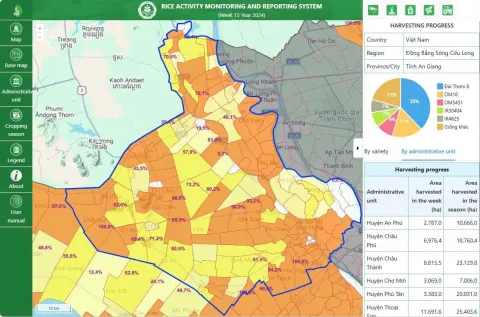
Upgrading and Expanding the Digital System for Rice Production Activity Monitoring and Reporting (RiceMoRe)

RiceMoRe (Rice Activity Monitoring and Reporting system) is a georeferenced digital platform developed since 2018 by IRRI in collaboration with Vietnam’s Department of Crop Production and the Center
03/2026 - 03/2027

Technical Assistance for Advancing the Adoption of CSA/Smart/4IR Practices under Repurposing of Agricultural Public Support Towards a Sustainable Food System Transformation in Bangladesh (TARAPS) program

Rice is the backbone of Bangladesh’s food system, contributing more than 70% of national calorie intake and supporting the livelihoods of over 13 million farming households. Over the years, agricult
01/2026 - 12/2027

Pioneering Rice Resilience Project

Rising soil salinity is a growing threat to rice production worldwide, reducing yields and impacting farmer livelihoods. Despite this, there is limited understanding of how planting density and soil
11/2025 - 09/2030

Scaling Sustainable and Climate-Resilient Rice-Based Cropping System in Uttar Pradesh (UPAGREES Project)

The rice-wheat cropping system of Uttar Pradesh is vital to India’s food security, with the state contributing nearly 31% of the country’s wheat production and 13.8% of rice production. However, Eas
04/2026 - 10/2027

AI-designed Synthetic Microbial Communities for Reducing Greenhouse Gas Emissions, Improving Biological Nitrogen Fixation and Enhanced Disease Resistance in Rice (AI-SynCom-Rice)

Rice production is currently challenged by high greenhouse gas emissions, low nitrogen uses efficiency (NUE), and losses from major diseases. Solving these together requires solutions that cut emiss
10/2024 - 12/2028

Promoting Climate-Resilient Livelihoods in Rice-Based Communities in the Tonle Sap Region in Cambodia

Cambodia’s rice-based agricultural communities, particularly those in the Tonle Sap region, face growing vulnerability to climate change. Forecast trends in the country predict intense wet and dry s
10/2021 - 10/2027

Capacity-building for Higher Education and the Establishment of Genome Agricultural Research Center at the University of the Philippines Los Banos

The project aims to establish a state-of-the-art Agricultural Genomics Research Center (AGRC), a hub for genomics research and collaboration between the University of the Philippines – Los Baños (UP
01/2025 - 07/2028

Advancing Climate-Smart Technologies to Strengthening Rice Farming in Thailand

Rice is Thailand’s most important food crop, accounting for roughly half of Thai agricultural land and employing 18 million smallholder farmers. Rice farmers are among the poorest occupational group
09/2024 - 12/2027

Accelerating scaling of Low-Emissions Rice (AcceLER)

Rice production is a significant source of greenhouse gas (GHG) emissions, particularly methane. Globally, approximately 10-11% of all methane emissions come from rice fields. In rice-producing coun