IRRI explores research collaboration with FMC to strengthen rice production in Africa
By Melanie Connor
The International Rice Research Institute (IRRI) participated in FMC Agro Italia’s Rice Portfolio: Cultivating Opportunity meeting, held in Milan, Vercelli, and Novara, Italy, last 15–16 September 2026. The event brought together scientists from the agricultural solutions company, various research institutions, and rice-industry stakeholders to examine advances in rice production, crop protection, varietal development, and seed systems.
For IRRI, the meeting was an opportunity to present its work in Africa and explore how public-sector research and private-sector innovation can work together to address productivity constraints in diverse rice-growing environments.
Showcasing IRRI’s work in Africa
IRRI Senior Scientist Dr. Melanie Connor represented the institute and delivered a presentation on its research and development activities across Africa. She highlighted IRRI’s efforts to improve rice productivity, strengthen the resilience of production systems, and connect research innovations with the needs of farmers and other rice value-chain actors.
IRRI positioned itself as a potential research partner for evaluating new technologies under African conditions, where cropping practices, weed pressures, water management, and farmers’ access to inputs often differ substantially from those in established rice-producing regions such as Europe.
A key message from IRRI’s participation was that technologies developed elsewhere must be assessed in the environments where they are intended to be used. Local research is essential to determine their technical performance, suitability, economic value, and practical relevance for farmers.
Field insights on crop protection
The program included visits to FMC’s experimental rice fields showcasing crop-protection innovations. Participants observed the technologies under field conditions and discussed their potential role in addressing production challenges, particularly weed management.
Weed competition remains a major constraint to rice productivity in many African systems. It can reduce crop establishment and yields while increasing labor demands and production costs, especially where farmers have limited access to effective and affordable weed-management options.
IRRI noted that emerging crop-protection technologies should be evaluated as part of integrated rice production systems. Their value will depend not only on weed-control performance, but also on crop tolerance, compatibility with locally grown varieties, application requirements, cost, environmental considerations, and fit with different irrigation and crop-establishment practices.
Potential areas for future research include performance against locally important weed species, crop response across African rice varieties, suitability under varied water-management systems, and implications for labor, costs, and productivity. IRRI emphasized that these are research questions; field testing would be required before drawing conclusions about performance or suitability in Africa.
Learning from breeding and seed systems
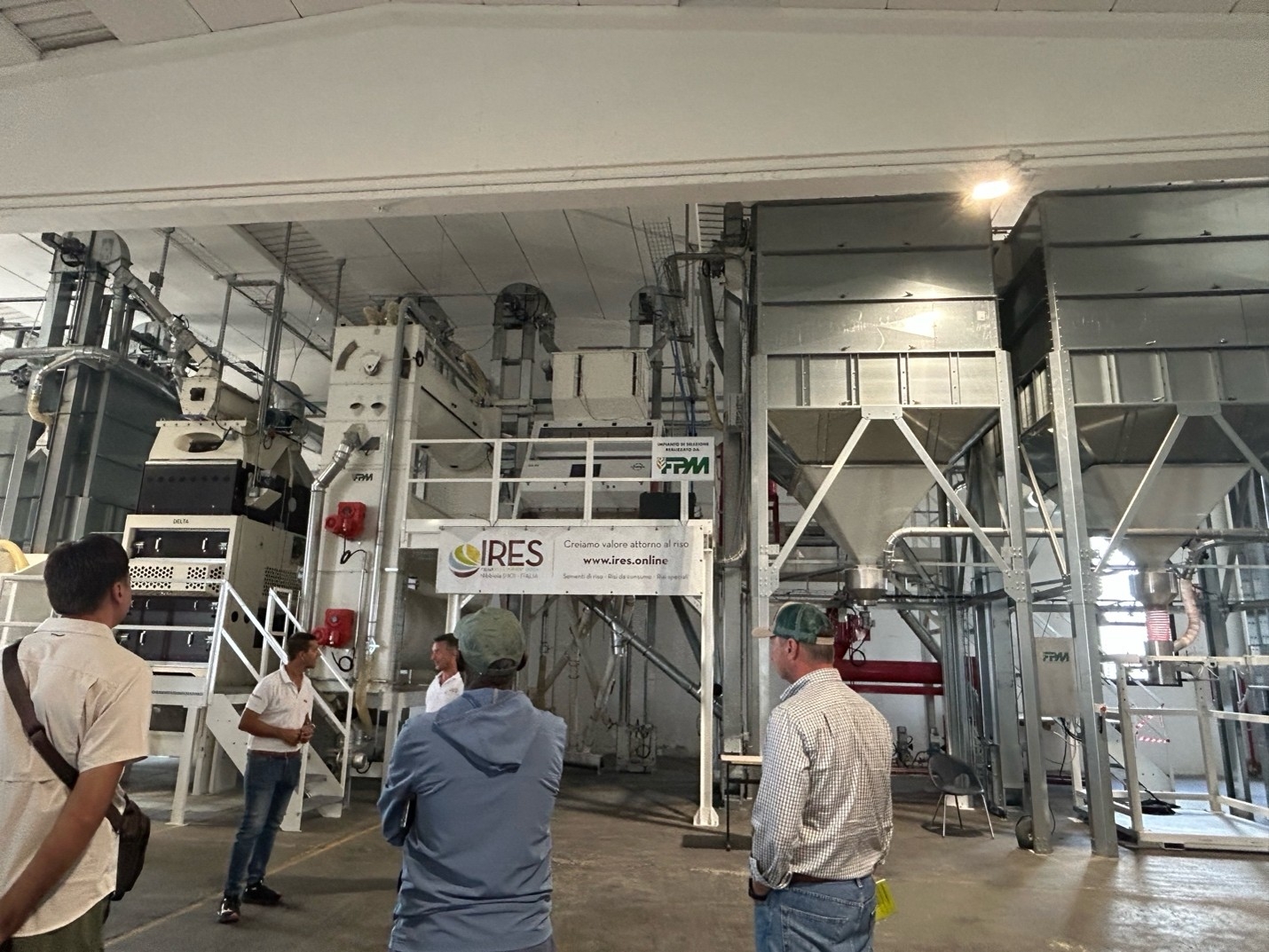
The delegation also visited rice varietal trials linked to ENR and SeedCo, as well as the Italian Rice Experiment Station (IRES) in Nibbiola and its seed-production facility in Prarolo. The visits illustrated how varietal evaluation, seed production, grain quality, and market demand are closely linked in a functioning rice sector.
These insights are highly relevant to IRRI’s work in Africa, where improved varieties must be supported by accessible seed systems and responsive markets to achieve widespread adoption and impact.
Toward a potential partnership
A central outcome of the meeting was an initial discussion on possible collaboration between IRRI and FMC, particularly field trials to evaluate crop-protection technologies in selected African countries. Such a partnership could combine FMC’s crop-protection expertise with IRRI’s knowledge of African rice systems, research capacity, and national partnerships.
Any collaboration would be embedded in existing country priorities and national research partnerships. IRRI also stressed that technical evaluation must remain separate from commercial deployment, which would require attention to regulation, safety, stewardship, affordability, and farmer access.
The meeting established a constructive foundation for further engagement. Potential next steps include clarifying technologies available for evaluation, identifying trial locations, developing a research framework, and engaging national research and regulatory partners.