Bridging science, capital, and partnerships to transform Asia’s agrifood systems
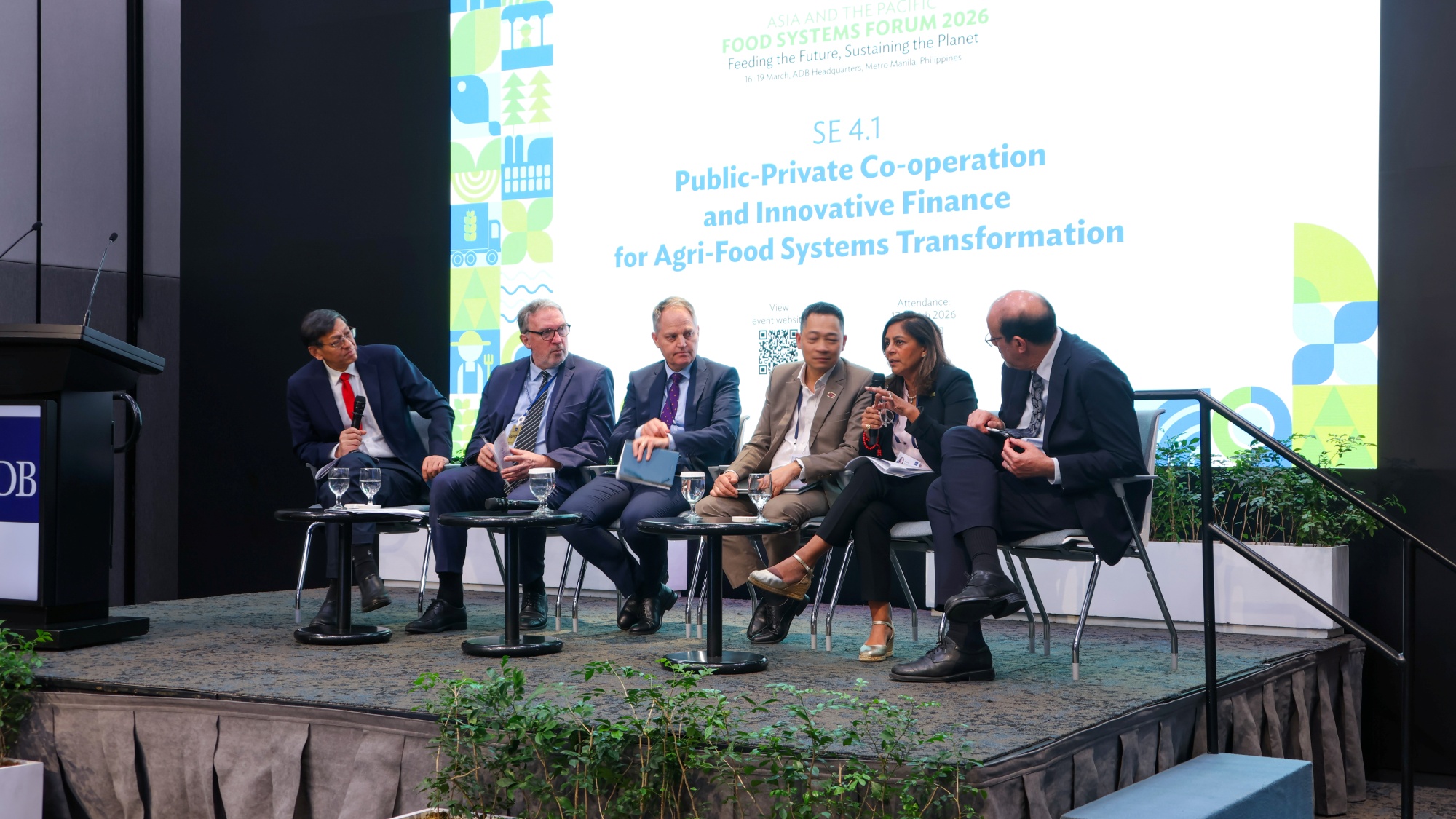
Manila, Philippines (17 March 2026) — At the Asia and the Pacific Food Systems Forum 2026, hosted by the Asian Development Bank (ADB), a clear message emerged from leaders across CGIAR, development finance, and the private sector: transforming agri-food systems is no longer just a question of innovation, but of alignment between science and finance, public goods and private incentives, and, critically, between ambition and execution.
Across two high-level roundtables on public–private cooperation and innovative finance, speakers explored how this alignment can move solutions beyond pilots and into large-scale investments that deliver real impact for farmers, markets, and economies in the region.
The challenge, as speakers noted, is not a lack of innovation but a gap between innovation and scale. At the center of this conversation was the ADB–CGIAR Clearinghouse Facility, an innovative finance mechanism, designed to bridge these divides.
“Closing that gap requires rethinking how different types of capital work together,” said Ruben Echeverria of the Gates Foundation. “Every dollar looks the same, but it’s not the same. Public finance, private investment, and philanthropy each play distinct roles and only by combining them can systems truly shift.” Philanthropy, he explained, helps absorb early-stage risks and coordination costs, enabling innovation to move forward. Public finance provides the scale and long-term commitment, while private capital brings efficiency, discipline, and sustainability. “Philanthropy pilots and proves, sovereign funding scales, and private finance sustains.” The ultimate goal is to create a continuum of financing and support, which is already being operationalized through platforms like the ADB–CGIAR Clearinghouse.
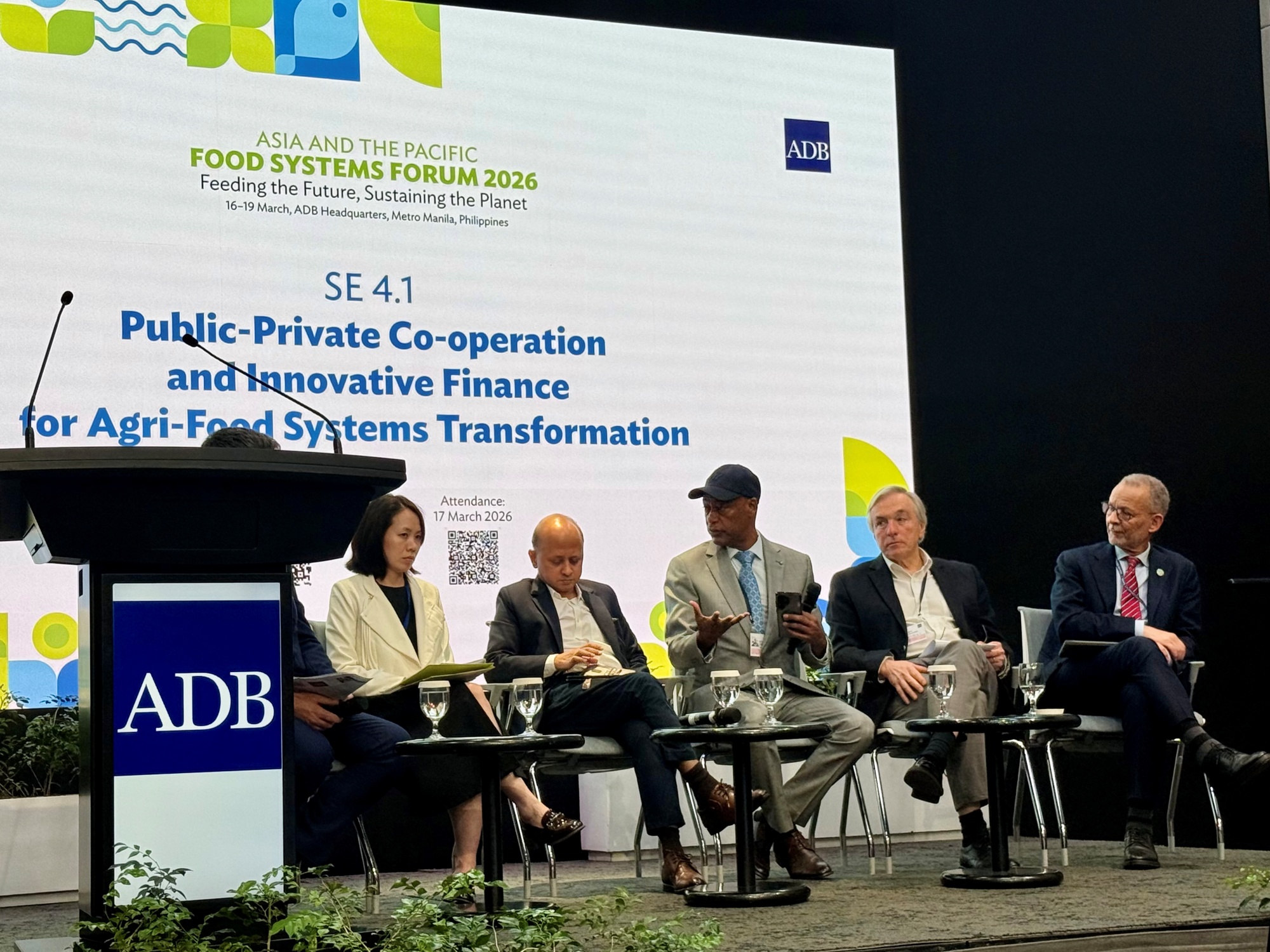
Drawing on experience from Africa, Dr. Solomon Gizaw of the International Institute of Tropical Agriculture (IITA) described how the Technologies for African Agricultural Transformation (TAAT) Clearinghouse has successfully linked science to investment by packaging technologies into formats that governments and financiers can adopt at scale. “We bring science-based technologies into large-scale investment design,” he explained, reaching millions of farmers and turning agriculture into a business. The results are tangible with the project influencing $1.5 billion in annual investments and deploying over 100 technologies across African countries, promoting stronger connections between farmers and markets.
CGIAR’s livestock research also offers another example of building ecosystems for scaling innovations. International Livestock Research Institute (ILRI) Regional Representative for Asia Dr. Hung Nguyen highlighted the Index-Based Livestock Insurance (IBLI), which uses satellite data to trigger drought insurance payouts, enabling pastoralists to protect their herds without costly field verification.
In 2023, the World Bank committed $360 million to the De-risking, Inclusion, and Value Enhancement of Pastoral Economies in the Horn of Africa (DRIVE) project, with IBLI as the central financial instrument, now operating across Kenya, Ethiopia, Somalia, and Djibouti, targeting 1.6 million pastoralists. Over 800,000 people were already reached in Kenya alone in 2024. “Building it required sustained engagement with a complex ecosystem, national regulators, private insurers, reinsurers, government social protection programs, and pastoralist communities themselves. That engagement was not peripheral to the science; it was part of building something that could actually function at scale.”
Crucially, CGIAR's Africa experiences, specifically with the TAAT model, demonstrate that science can be translated into investment-ready solutions and embedded into national programs.
Building on this model, the ADB–CGIAR Clearinghouse Facility is beginning to show early promise in Asia. According to its head, Xi Cao, the platform has already supported the design of a program in the Philippines projected at $600 million, within just months of becoming operational. “We are turning small-scale innovations into large-scale programs,” she said. By integrating CGIAR’s scientific evidence at the earliest stages of ADB’s project design, the Clearinghouse is helping ensure that investments are not only larger, but smarter and more closely aligned with national development priorities and the real-world needs of smallholder farmers.
For ADB, this means more effective use of its growing portfolio, including its ambition to invest up to $40 billion in food systems transformation by 2030. For CGIAR, it offers a pathway to scale decades of research beyond pilots and into national development programs. And for countries, it delivers solutions that are grounded in both science and implementation realities. Yet even with stronger platforms and partnerships, scaling transformation requires confronting a fundamental reality: public and private sectors operate under different logics, and both are essential.
From the private sector perspective, Suhas Joshi, Carbon Initiative Director of Bayer South Asia highlighted the discipline and speed that businesses bring, alongside the constraints they face. “The private sector brings efficiency and fast decision-making but it must generate returns. That limits where it can invest. This is where public investment plays a key role, particularly in areas that generate broad societal benefits but may not yield immediate financial returns.” Climate resilience, certain crops, and early-stage innovations often fall into this category. “Rather than competing, these roles are complementary,” Joshi added.
Public investment can create the enabling environment and absorb risk, while private capital can scale viable solutions and sustain them over time. The challenge and opportunity are to align these contributions across entire value chains.
Several speakers emphasized that achieving this alignment requires not just financing, but evidence. Dr. Yvonne Pinto, CGIAR Asia Pacific Regional Representative and Director General of the International Rice Research Institute (IRRI) underscored the importance of understanding and measuring returns on investment. “This notion of being able to measure and reflect what that return on investment is, is critical,” she said, pointing to examples where CGIAR innovations have already informed billions of dollars in investments and reached millions of farmers.
Supporting this, International Food Policy Research Institute (IFPRI) Director General Dr. Johan Swinnen highlighted a key constraint in translating impact into financing. “Productivity is relatively straightforward to quantify but when it comes to quality, safety, and especially sustainability standards, measurement becomes far more complex. If we cannot measure these dimensions, we cannot assign value to them. And without clear value, it becomes very difficult to attract the financing needed to scale solutions.”
At the same time, advances in data and analytics are reshaping how decisions are made. International Water Management Institute (IWMI) Director General Dr. Mark Smith noted that new technologies, including AI, are helping overcome long-standing data fragmentation challenges. “This is enabling better planning, better investment decisions, and faster action,” he said.
But perhaps the most important shift discussed during the session was moving from scaling projects to transforming systems. “We’re limiting ourselves when we think about scale only in terms of finance or technologies,” Pinto reflected. “What we should be looking for is growth at the country level.” This broader perspective recognizes that sustainable transformation depends on building ecosystems, where farmers, agribusinesses, service providers, and financial actors are connected in ways that endure beyond individual projects. It also highlights the importance of linking rural and urban economies, creating opportunities for youth, and strengthening value chains that can absorb and sustain innovation over time.
Swinnen reinforced this systems approach, noting that success depends on ensuring all actors in the value chain benefit. “If one part of the system doesn’t work, the system won’t work,” he said, emphasizing the importance of balancing efficiency, equity, and risk. With ADB’s significant financial commitments on the table, the question becomes not just how much to invest but where and how to invest for maximum impact.
Assistant Director General and Director of the FAO Investment Centre Dr. Mohamed Manssouri added that unlocking greater investment will also depend on strengthening the capacity of agri-food systems to absorb it. He emphasized that on-farm investments, ranging from mechanization to improved access to inputs, remain a significant but underdeveloped opportunity, noting that as farmers become more organized and productive, they can better attract and sustain private sector engagement.
Nobel Laureate and Director of the University of Chicago Development Innovation Lab Dr. Michael Kremer offered a clear answer. “Focus public funds where they are most needed and where returns are highest. Public funds are scarce, and we should target them toward public goods,” he said, pointing to agricultural research and farmer information systems as examples with exceptionally high returns. Such strategic investment, combined with strong partnerships and platforms like the ADB-CGIAR Clearinghouse, can help unlock far larger flows of private capital, multiplying the impact of every dollar.
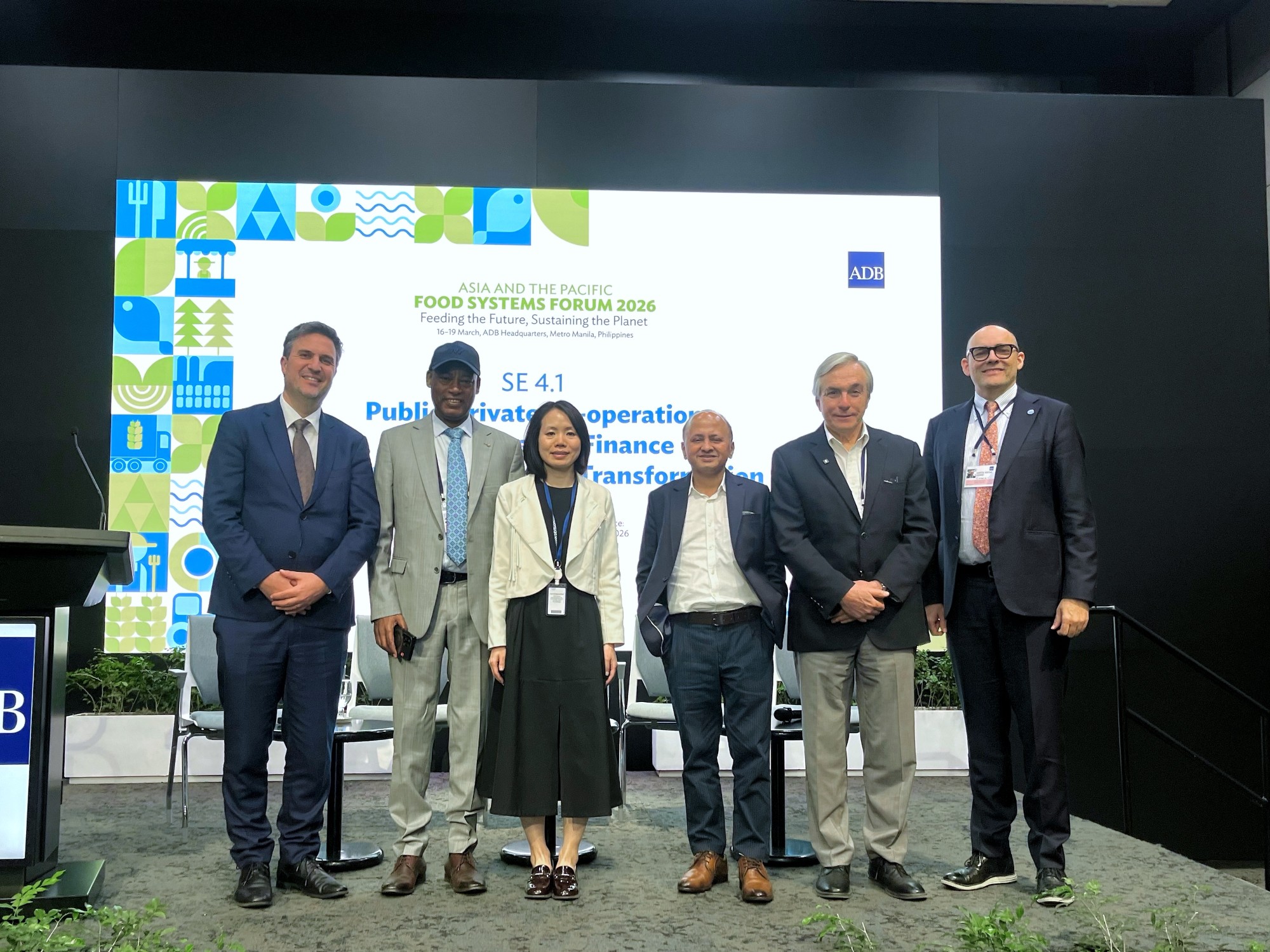
In Asia and the Pacific, this notion of matchmaking has begun to take shape through the combined efforts of CGIAR, development partners, and the private sector. CGIAR panel speakers illustrated examples such as the African Cereal & Legume Breeding Consortium by the African Seed Trade Association (AFSTA) and IITA-led TAAT program, the World Bank-supported Kerala Climate Resilient Agri-Value Chain Modernization Project (KERA) between the Government of Kerala, IRRI, and partners, the IWMI-Tata Trusts partnership on the Solar Pump Irrigators’ Cooperative Enterprise (SPICE) project and the SDC-supported Solar Irrigation for Agricultural Resilience (SoLAR) project.
Read more about the ADB CGIAR Clearinghouse Facility.
Learn more about CGIAR.