South Asia races to future-proof rice as climate pressure mounts
IRRI and its NARES partners embrace region-wide push to modernize rice breeding amid rising climate and food security risks
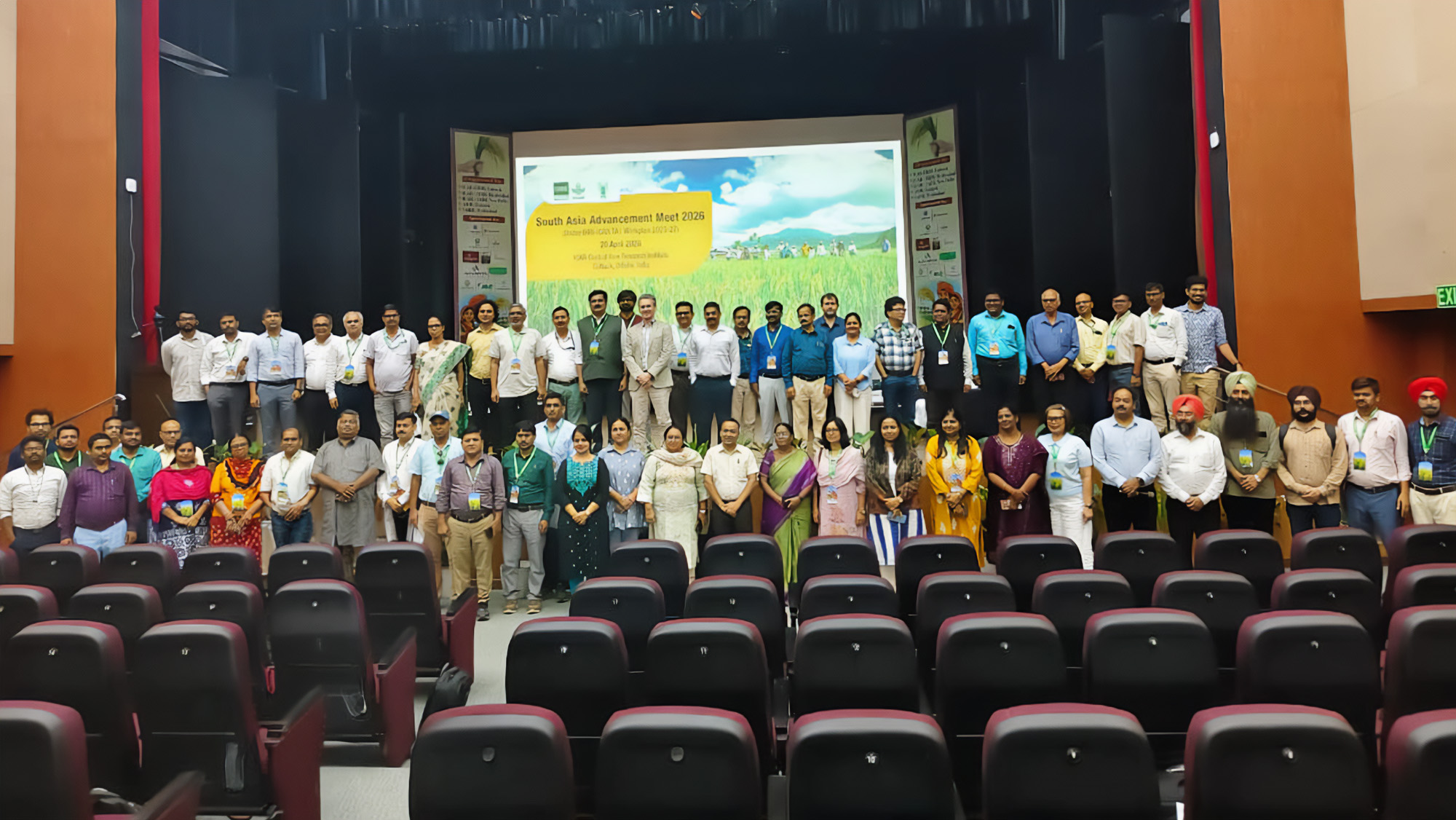
CUTTACK, India (20 April 2026) — IRRI and its National Agricultural Research and Extension Systems (NARES) partners are strengthening the “OneRice Breeding Strategy” by modernizing how rice varieties are developed, tested, and delivered, in a bid to speed up the release of climate-resilient rice across South Asia under a warming climate.
Dr. RM Sundaram, Director of Indian Council of Agricultural Research-Indian Institute of Rice Research, Dr. GVK Kumar, Director of ICAR-Central Rice Research Institute, and Dr. Vikas Kumar Singh, Lead for ISARC ad interim, coordinated the South Asia Advancement Meeting under the IRRI-ICAR workplan.
The One Rice Breeding Strategy aims to bring together rice breeding efforts across IRRI and national research institutions through a more coordinated regional system. By connecting data systems, testing networks, and breeding programs, the strategy helps reduce duplication, improve decision-making, and accelerate the development and release of rice varieties that better meet farmer and market needs.
The transition responds to the “Minus 5 plus 10” challenge, where the region is projected to lose around 5 million hectares of rice land to climate change and competing land use, while needing to produce an additional 150 million metric tons of rice.
Rebuilding how rice is bred and delivered
Dr. Michael Quinn, IRRI Research Director for Rice Breeding Innovations, said stronger coordination is now critical as climate stress, pest pressure, and demand for rice continue to rise.
Through the One Rice strategy, roles are becoming more clearly defined. IRRI develops advanced breeding materials, while NARES partners lead testing, variety release, and farmer adoption, supporting a more market-oriented system built on co-creation.
Dr. Quinn further emphasized that breeding must go beyond yield and be guided by end-user demand, combining consumer-preferred grain quality with farmer-valued traits such as yield potential and tolerance to drought, flood, salinity, and pests.
“For a new variety to be successful, it must offer significant improvement over existing options. Farmers are not going to replace what they are currently growing unless there is a step change,” he said.
Dr. Quinn added that advancement meetings now serve as key decision points to compare new rice lines with existing varieties before they move forward. “IRRI does not release varieties, so our success depends entirely on our partners,” he said. “Your success is our success at IRRI, and we are fully committed to supporting it.”
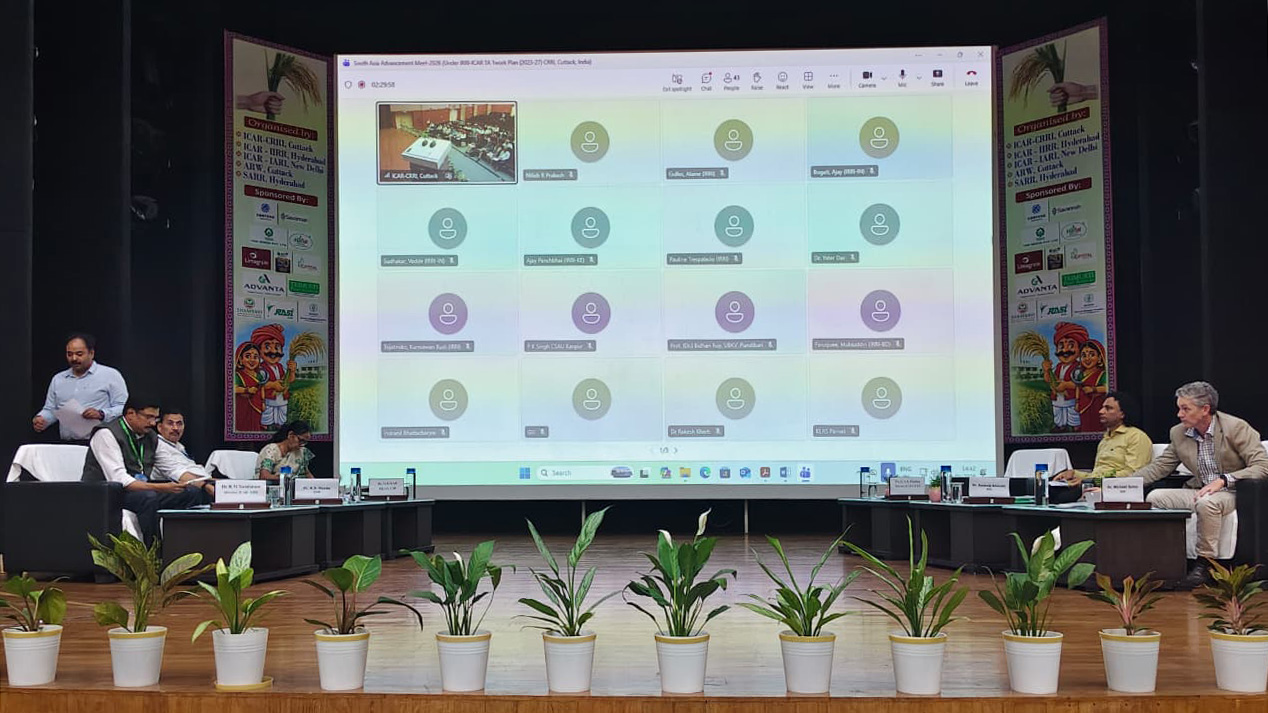
Supporting this, ICAR-IIRR Director Dr. RM Sundaram highlighted that India is shifting toward more market-oriented breeding. “There is no point in just advancing varieties for yield alone. Let’s also look into some of these key grain and cooking quality parameters,” he said, noting that breeding work is now more focused on what the market actually wants.
With support from partners, he added, preferences have been mapped for two key rice types, short slender and medium slender, helping to speed up the development of varieties that better match farmer and consumer demand.
Joint Crossing Block
Dr. Sankalp Bhosale, IRRI's Deputy Platform Head, provided updates on IRRI's efforts to coordinate the Joint Crossing Block, which is jointly overseen by ICAR-IIRR's Dr. R. M. Sundaram and IRRI's Dr. Vikas K. Singh.
He mentioned that future breeding efforts should be co-created with NARES, emphasizing the need to breed and test these efforts in the TPEs.
JCB activities are implemented in collaboration with five partner institutions across India: Acharya N. G. Ranga Agricultural University (ANGRAU), Tamil Nadu Agricultural University (TNAU), ICAR–Indian Institute of Rice Research (IIRR), Professor Jayashankar Telangana Agricultural University (PJTAU), and Dr. Balasaheb Sawant Konkan Krishi Vidyapeeth (DBSKKV).
Data-driven breeding modernization
Breeding is increasingly guided by digital platforms such as BioFlow and IRRI-developed dashboards shared with NARES partners. These systems integrate multi-location trial data with weather, genetic, and trait information, providing real-time updates in one view. This helps identify high-performing rice lines faster, reduces duplication, and speeds up the selection of promising varieties.
Breeding pipelines are now structured by maturity duration and production environment, with IRRI scientists presenting updates:
- In the early-maturity pipeline, the focus is western India, using PR 126 as a benchmark variety. Dr. Shalabh Dixit discussed that several lines from 2025 trials delivered a 5–10% yield advantage over PR 126, resulting in 30 elite lines moving to the next stage of testing.
- In the medium-duration pipeline, long-slender grain types are transitioned toward small-slender rice in response to market demand. Dr. Suresh Kadaru reported that genetic gain has increased to 1.66%, compared with historical levels of about 0.45%, showing improved breeding efficiency.
- In the late‑duration breeding pipeline targeting complex salinity and flooding ecologies, Dr. Mahender Anumalla presented results from the multi‑location trials in India and Bangladesh. Several elite rice lines demonstrated enhanced submergence tolerance (16–21 days), dual tolerance to flash and stagnant flooding, and superior post‑flood recovery. Concurrently, promising salinity‑tolerant lines identified across coastal and sodic ecologies showed >15% yield advantage over local and global checks.
CGIAR's Breeding for Tomorrow Science Program further strengthens this framework by embedding market intelligence into breeding decisions, enabling continuous refinement of target product profiles based on demand trends and end-user requirements. This ensures breeding outputs remain aligned with evolving market and production system needs.
Hybrid rice and AI-enabled breeding
Hybrid rice development focuses on increasing yield potential while reducing seed production costs. Dr. Jauhar Ali of IRRI reported that new hybrids show more than 25% yield advantage over conventional varieties, while seed production costs have been reduced by up to 45%.
Artificial intelligence-based cross-prediction tools are also being used to improve efficiency. These tools identify promising parental combinations with up to 90% accuracy, reducing the need for large numbers of manual crosses.
Some hybrids also show environmental benefits. Mestizo 120, for example, has been identified as a low-methane-emitting hybrid, partly due to shorter crop duration that reduces the time fields remain flooded.
Pre-breeding and trait discovery
IRRI's pre-breeding program is mining rice landraces to introduce useful traits into elite breeding lines such as IRRI 154. Dr. John Damien Platten of IRRI reported that around 68 genes have been incorporated, including those linked to resistance against bacterial blight, rice blast and brown planthopper.
Work is also improving nutrition and resilience. The qZn5 gene increases grain zinc content by 25–40% without reducing yield. Additional efforts to improve resistance to root-knot nematode, brown spot and false smut are bearing fruit.
Seed systems and scaling impact
IRRI India Country Manager Dr. Swati Nayak, leading the Seed Accelerator Network (SAN), reported faster replacement of outdated varieties in states such as Odisha, India. The average age of rice varieties in use has dropped to around 6–7 years, replacing older varieties such as Swarna and MTU 1010 that previously dominated production systems.
This acceleration in varietal turnover is estimated to generate about US$565 million in additional annual income for rice farmers in India, driven by faster adoption of improved varieties and stronger links between breeding and seed delivery systems.
Strengthening long-term collaboration
In response to these efforts, Dr. RM Sundaram highlighted the growing importance of rice breeding under climate change. “The role of crop breeding has never been more important,” he said, noting the long-standing collaboration between IRRI and ICAR through joint crossing blocks, which has led to the development of several rice varieties.
“The entire world is facing increasing vulnerability in rice production due to climate change,” he added, pointing out that many improved Indian varieties rely on donor parents developed or provided by IRRI, reflecting the depth of this collaboration.