Designing inclusive digital agroadvisories for climate-resilient food systems
by Niyati Singaraju, Shalini Gakhar
Climate change poses growing risks to food systems in India, disproportionately affecting smallholder farmers, women, and marginalised communities. Digital agro-advisories have emerged as a promising tool to support climate-resilient agriculture by delivering timely, localised, and actionable information (FAO, 2024, The unjust climate – Measuring the impacts of climate change on rural poor, women, and youth). However, gaps remain in ensuring these advisories are inclusive, user-centred, and responsive to diverse socio-economic and agroecological contexts. Digital technologies, particularly advances in artificial intelligence (AI), data analytics, and remote sensing, are transforming the way agricultural advice is generated, tailored, and delivered. When effectively designed, these advisories can reduce information asymmetries, improve the timeliness and accuracy of recommendations, and enable smallholder farmers to access climate, crop, and market information (Technology and Innovation Report, Inclusive Artificial Intelligence for development, UN 2025).
Persistent challenges related to uneven digital access, data quality, contextual relevance, weak feedback loops, and institutional sustainability limit both adoption and impact (Annarita, 2026 et. al). Addressing these gaps requires more than technological innovation alone; it calls for intentional design, strong partnerships, robust data and governance systems, and an explicit commitment to inclusion throughout the advisory lifecycle.
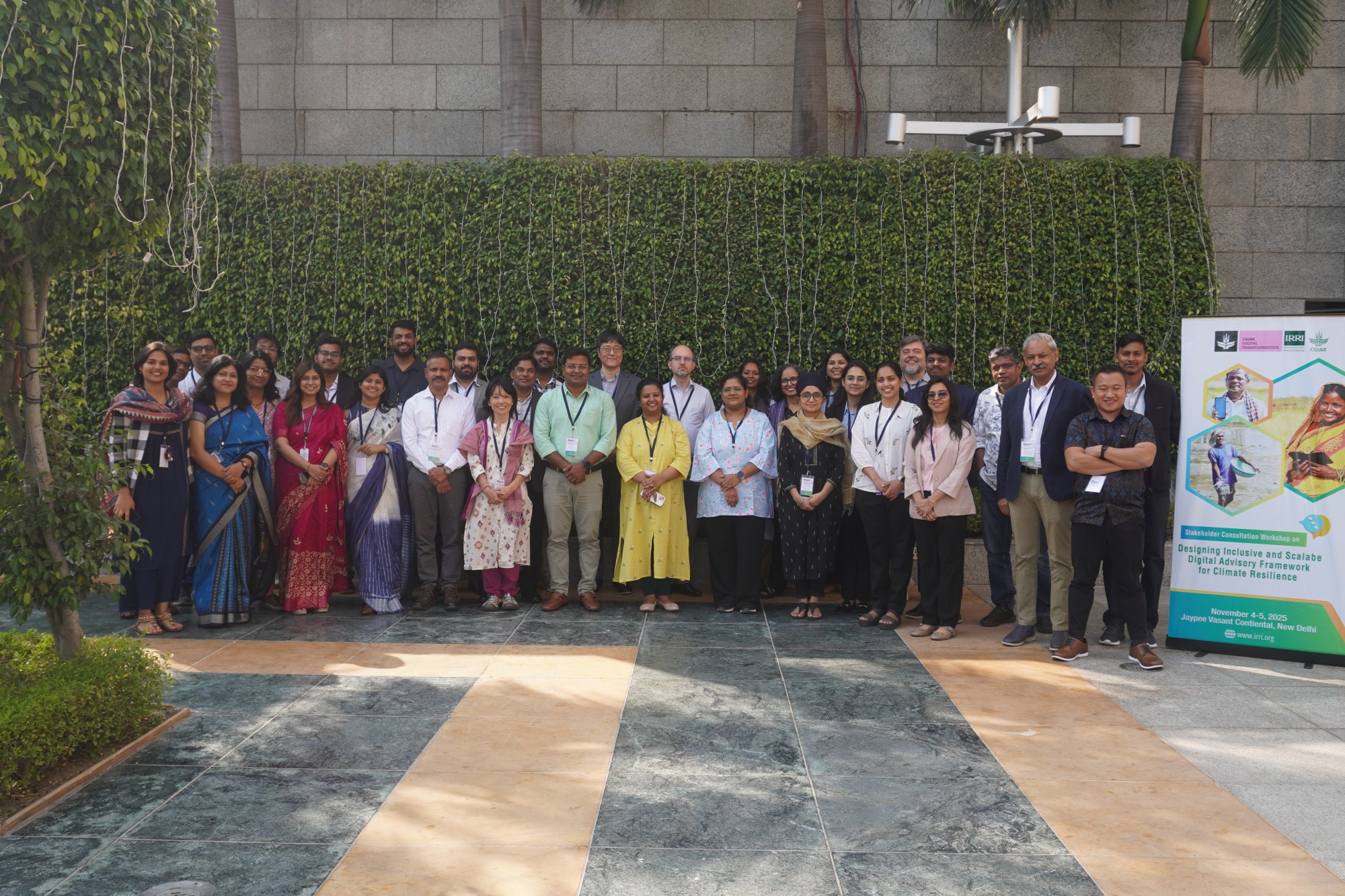
Against this backdrop, the Stakeholder Consultation Workshop on Designing Inclusive and Scalable Digital Agroadvisory Frameworks for Climate Resilience, convened by the CGIAR Digital Transformation Accelerator (DTA) and led by the International Rice Research Institute (IRRI), brought together diverse actors to reflect collectively, learn, and co-create pathways toward more effective digital advisory systems. Held in New Delhi on 4–5 November 2025, the two-day workshop brought together participants from research organisations, government agencies, private-sector technology providers, NGOs, and development partners in India. The objective was clear: to move beyond fragmented initiatives and contribute to a shared, actionable framework for inclusive and climate-resilient digital agro-advisories.
Understanding the digital agro-advisory landscape
The workshop began with a structured assessment of the current digital agro-advisory landscape. Through facilitated mapping exercises, participants examined the types of advisories in use, their target users, delivery channels, maturity stages, and the extent to which inclusion considerations are currently embedded.
Across stakeholder groups, a diverse ecosystem emerged, including AI-enabled chatbots, IVR-based systems, mobile applications, satellite- and drone-supported advisories, and hybrid models that combine digital tools with public and private extension services. While this diversity reflects substantial innovation, common constraints were consistently identified. Participants highlighted persistent challenges related to data quality and validation, limited two-way communication, uneven digital infrastructure, and the continued marginalization of women and resource-constrained farmers in the design and deployment of advisory services.
A recurring insight was that digital tools alone are insufficient. Human intermediaries such as extension workers, farmer-producer organisations, self-help groups, and community facilitators remain central to building trust, interpreting recommendations, and supporting behavioural change. Participants emphasized that farmers value advice that is timely, context-specific, and actionable, and that poorly coordinated or conflicting advisories can undermine confidence and adoption.
Building a shared understanding of inclusion
To support collective design and decision-making, participants worked toward a shared understanding of four core dimensions of effective digital agroadvisories: accessibility, relevance, usability, and sustainability. While interpretations varied across institutional and regional contexts, strong convergence emerged.
Accessibility was closely associated with affordability, availability, and the ability to overcome barriers related to connectivity, devices, and digital literacy. Relevance was defined by timeliness and contextualization, ensuring advisories align with local agroecological and decision-making contexts. Usability emphasized clarity, user-centric design, and alignment with farmers’ capacities and practices. Sustainability was understood as long-term viability, grounded in trust, institutional ownership, viable financing models, and continuous learning.
Defining guiding principles for inclusive digital agroadvisories
Building on these discussions, participants identified eight guiding principles to support inclusive and scalable digital agroadvisory systems. Seven were prioritised as core principles, supported by one crosscutting, foundational pillar:
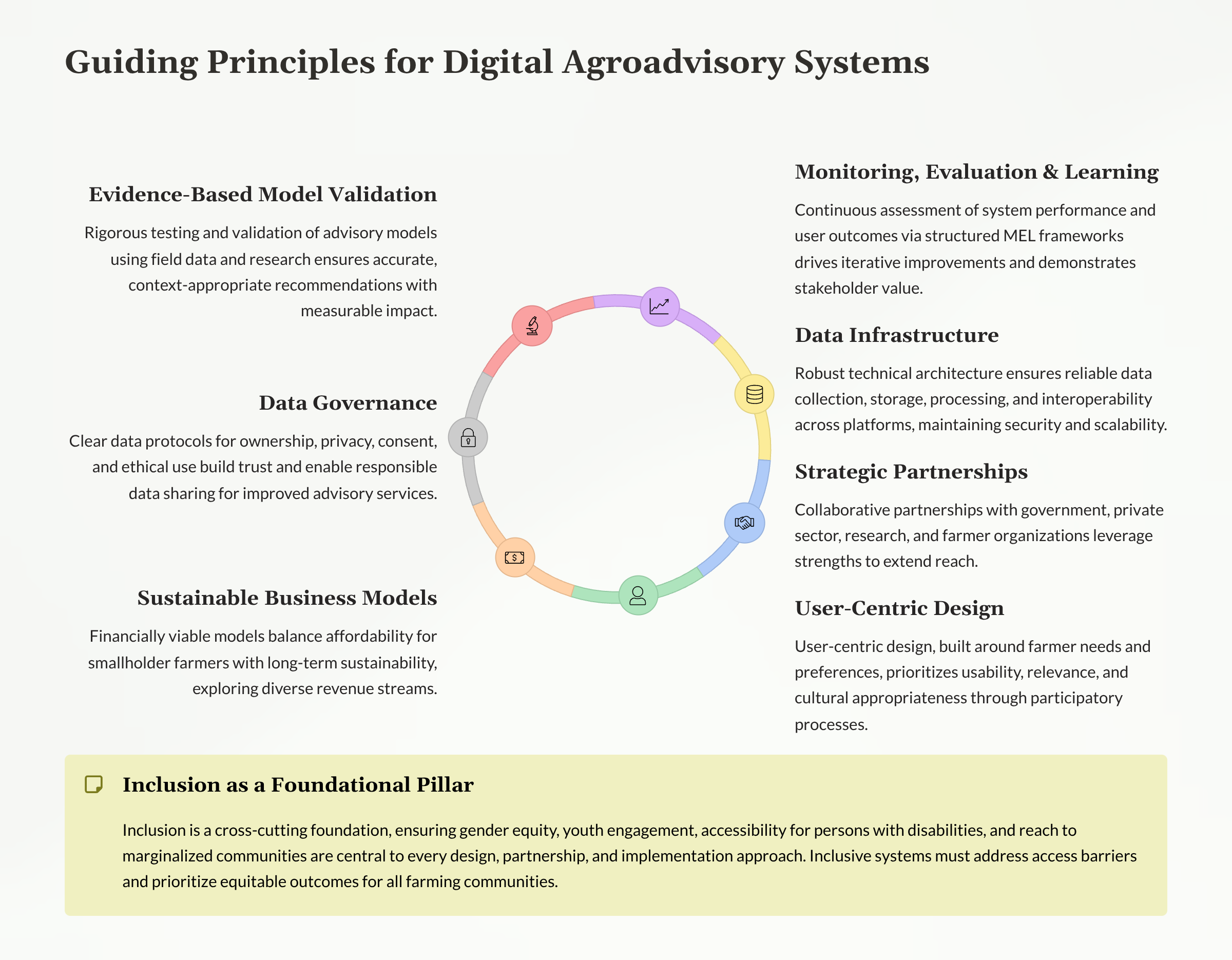
Together, these principles reflect a shared recognition that effectiveness, trust, and inclusion must be embedded throughout the advisory lifecycle from data generation and model development to delivery, adoption, and scale. Participants emphasized their interdependence, noting that progress in one area is often contingent on progress in others.
From principles to strategic action and outcomes
The second day of the workshop focused on translating principles into practice. Mixed stakeholder groups synthesized the guiding principles into strategic pillars, identifying priority actions, key actors, enabling conditions, and intended outcomes across the stages of design, delivery, adoption, and sustainability.
Several priorities emerged clearly. Continuous user-centric co-design was identified as essential to ensure that farmer feedback informs iterative improvement rather than remaining confined to pilot phases. Robust monitoring, evaluation, and learning (MEL) systems were seen as critical for adaptive learning, accountability, and understanding differential reach and impact across user groups. Ethical data governance was emphasized as a foundational requirement for trust, fairness, and compliance, particularly as AI-driven systems become more prevalent. Viable business and partnership models were recognized as central to sustainability, balancing affordability for farmers with long-term institutional commitment.
The resulting framework links these actions to intended outcomes: smallholder farmers empowered with timely, relevant, and inclusive advisories; FAIR-aligned (Findable, Accessible, Interoperable, and Reusable) and interoperable data ecosystems; strengthened institutional and partnership capacity for co-creation; supportive policies and business models; and continuous learning mechanisms that improve advisory quality and impact over time.
Sustaining engagement and collective learning
Participants strongly emphasized that the framework should remain a living construct, refined through continued engagement, empirical evidence, and practice-based learning. To sustain momentum, the CGIAR Digital Transformation Accelerator (DTA) will convene a Community of Practice (CoP) bringing together stakeholders from research, government, the private sector, NGOs, and academia. The CoP will provide a platform for peer exchange, coordination, and joint problem-solving across digital agroadvisory initiatives, with a particular focus on inclusion, scale, and climate resilience.
This will be complemented by a structured learning series, including thematic webinars, case-based discussions, and technical dialogues, designed to catalyse and synthesise learning across contexts. Priority topics will reflect areas highlighted during the workshop, such as inclusive user-centric design, data governance and ethics, MEL for adaptive systems, and sustainable partnership and business models.
In parallel, a Digital Agroadvisory Framework Information Brief will be developed, synthesizing insights from stakeholder consultations, structured discussions with farmers and extension staff, and a targeted review of existing evidence and literature. Together, these efforts aim to strengthen enabling conditions, policy alignment, institutional capacity, interoperable data systems, and continuous learning while supporting more coordinated and evidence-informed approaches to inclusive digital agro-advisories.
A foundation for collective action
The workshop aimed to deliver a shared starting point for continued collaboration under the CGIAR Digital Transformation Accelerator. As climate risks intensify and digital technologies continue to evolve, the challenge ahead is not only technical but institutional and social which is to ensure that innovation translates into equitable, climate-resilient outcomes. The insights from this consultation reaffirm that inclusive digital transformation in agriculture is, fundamentally, a collective endeavour.